

How to Choose the Best Probiotic Supplement in New Zealand
Last Updated: November 14, 2026
Quick Summary
A probiotic supplement is a product containing live microorganisms intended to support the balance of bacteria in the gut. To choose one, first decide your goal, then read the label for full strain names, a CFU count stated at manufacture, a clear serving size, storage instructions and an expiry date.
- Decide your goal first: digestive comfort, antibiotic support, or daily gut health.
- Look for full strain names with species and strain code, not just the genus.
- Check whether the CFU count is stated at time of manufacture, not only at expiry.
- Compare cost per serving rather than the shelf price.
- Store the product as the label directs, since live cultures decline with heat and moisture.
Table of Contents
- What a Probiotic Supplement Should Do for You
- How to Read Probiotic Labels
- Probiotic Strains Explained
- Single-Strain or Multi-Strain: Which Suits Your Needs
- Probiotic Storage and Expiry: Keeping Your Supplement Alive
- Probiotic Side Effects, Safety and Medication Interactions
- Choosing Your Probiotic Supplement from bemo
- Frequently Asked Questions
What a Probiotic Supplement Should Do for You
Choosing a probiotic supplement starts with knowing what you want it to do. Shoppers in New Zealand often compare many options that look similar on the shelf but differ in strain, dose and format. A probiotic supplement is a product containing live microorganisms intended to support the balance of bacteria in the gut.
Most people buy a probiotic for one of three reasons: general digestive comfort, support during or after antibiotics, or a daily routine for overall gut health. Each goal points toward a different product. A product built for a short course of antibiotic support may not suit someone who wants a steady daily option.
Before you look at any label, decide which of these goals matches your situation. If you are unsure, speak with your pharmacist or healthcare professional, especially if you have a medical condition or take regular medication. Supplements are not a substitute for a varied diet and a healthy lifestyle.
How to Read Probiotic Labels
The label tells you more than the front of the bottle does. Start with three things: the strains listed, the dose, and the storage instructions. A clear label names each strain and states how many live cultures the product contains at the time of manufacture.
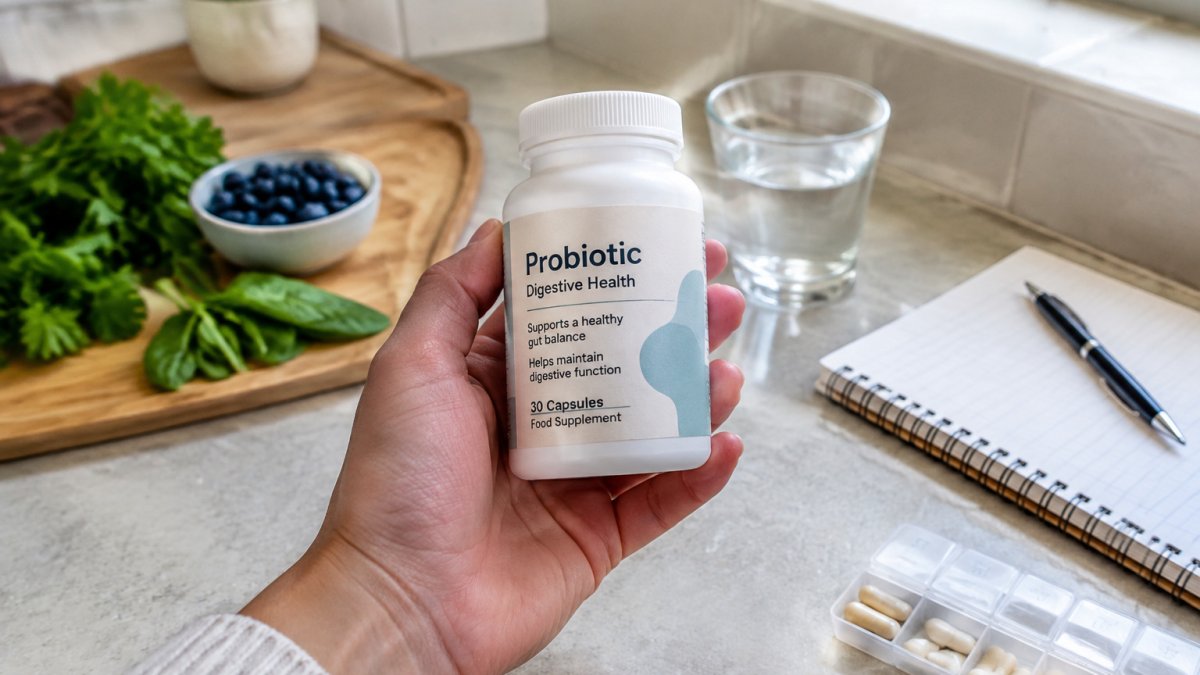
Hand holding a probiotic supplement bottle under kitchen lighting to read the label details
Look for the full strain name, not just the genus. "Lactobacillus" alone tells you little, while a full name such as Lactobacillus rhamnosus identifies a specific organism. Labels that list only general categories make it harder to compare products.
Check the recommended dosage and whether the product is suitable for your age group. Some products are designed for adults only, while others are formulated for children. The label should also state the serving size clearly, a capsule that delivers 10 billion CFU at one capsule per day is a different proposition from one that requires three capsules to reach the same figure.
CFU Count: What the Number Means and What It Doesn't
CFU stands for colony forming units, a measure of the live microorganisms that can form colonies in a laboratory test. A higher CFU figure is often used as a shorthand for strength, but it is not the whole story. A product with fewer CFUs and well-researched strains can suit some people better than a high-count product with unclear ingredients.
Also check whether the figure is stated "at the time of manufacture" or at expiry. Live cultures decline over time, so a count given at manufacture is a better guide to what the capsule contained when it was made. Be wary of comparing CFU numbers across products that measure them differently. A label that gives both the manufacture count and the expiry count is more transparent than one that gives only the higher figure.
Checking for Third-Party Testing and Manufacturing Details
Third-party testing means an independent laboratory checks that a product contains what the label states. This matters because supplement quality varies, and a label is only as good as the verification behind it. Look for clear statements about testing, manufacturing location and storage on the packaging or product page. A product that names the laboratory that tested it, or that carries a certification mark from an independent testing programme, gives you something concrete to check.
Manufacturing details also help. A product that states its cold chain handling, packaging method or manufacturing country gives you more to verify. Products that need refrigeration should be stored as the label directs. A manufacturer that can show its testing records is easier to trust than one that offers only a marketing description.
Spotting Filler Ingredients and Assessing Value
Turn the pack over and read the "other ingredients" or excipient list. Every supplement contains something beyond the live cultures, typically a carrier, an anti-caking agent or a capsule material. Common carriers include maltodextrin, microcrystalline cellulose and magnesium stearate. These are not automatically a problem, but a product that lists a long sequence of fillers, sweeteners and colours ahead of a modest culture count is usually poor value.
Compare the cost per serving rather than the shelf price. Divide the pack price by the number of servings to see what you actually pay per day, then weigh that against the strain list and the CFU count at expiry. A cheaper tub with a short expiry count can cost more per effective serving than a mid-priced product with a verified count. Watch out: a high CFU figure printed in large type on the front, with the strain list and expiry count buried in small print on the back, is a common pattern in products that compete on number rather than formulation.
What a Transparent Label Looks Like
A label you can trust tends to share the same features: full strain names with codes, a CFU count tied to a stated date, a clear serving size, storage instructions, an expiry date, and a manufacturer or distributor contact. It will also state any allergens and whether the product is suitable for vegetarians or vegans, which matters if you follow a restricted diet. If a product page omits the strain list or the expiry count, treat that as a reason to keep looking rather than a reason to guess.
The label tells you what matters most. Here is what to check on each one.
Label item |
What to look for |
Why it matters |
|---|---|---|
Strain names |
Full genus, species and strain code |
Matches the product to published research |
CFU count |
Stated at time of manufacture |
Shows what the capsule contained when made |
Serving size |
Clear dose per serving |
Shows how many capsules deliver the count |
Storage instructions |
Refrigerate or shelf-stable |
Live cultures decline with heat and moisture |
Expiry date |
Printed on pack |
Cultures weaken over time |
Other ingredients |
Carriers and fillers listed |
Long filler lists can signal poor value |
Testing details |
Named lab or certification |
Confirms the label matches the contents |
Probiotic Strains Explained
A strain is a specific variety of bacteria, identified by its genus, species and a strain code. Two products can both contain Bifidobacterium but behave differently because the strains differ. This is why reading the full strain list matters more than the product name.
Some probiotic blends contain eight or more strains, while others contain a single strain. Research on probiotics has largely studied specific strains rather than whole categories, so a strain's evidence applies to that strain only. Be cautious with claims that a generic "probiotic" will do everything.
Ask whether the strains listed have a track record in the health area you care about. Where a product names a strain's research base, you can check the cited study yourself.
Single-Strain or Multi-Strain: Which Suits Your Needs
Single-strain products contain one organism. They are simpler to understand and easier to compare, which can help if you have a specific goal and want to track how you respond.
Multi-strain products combine several organisms. They aim to cover a broader range of gut bacteria, and many of the high-count options on the market use this approach. The trade-off is that a blend is harder to attribute to any one strain's effect.
Neither format is automatically better. Choose based on your goal, your budget and whether you prefer a straightforward product or a broader one. Some shoppers start with a single strain to see how they feel before moving to a blend.
Probiotic Storage and Expiry: Keeping Your Supplement Alive
Live cultures are sensitive to heat, moisture and time, so storage affects how much the product delivers. Follow the storage instructions on the label exactly. Some products are shelf-stable and need no refrigeration. Others must be kept cold.
Check the expiry date when you buy and when you open the product. Once opened, some products should be used within a set period, and some need refrigeration to protect the cultures. Keeping a product in a hot bathroom cabinet or a sunny window can reduce its potency.
If you buy refrigerated products, check the delivery method. Some products that need cold storage should be handled in a way that keeps it at the required temperature from warehouse to your door.
Probiotic Side Effects, Safety and Medication Interactions
Most people tolerate probiotics well, but some experience mild effects in the first few days. Some people notice temporary bloating or gas as the gut adjusts. If you notice a change, check your product label for dosing guidance, and if symptoms persist, stop and speak with a healthcare professional.
Stop use and speak with a healthcare professional if you have serious side effects. People who are pregnant, breastfeeding, have a weakened immune system or have a medical condition should check with their doctor before starting a supplement. People who are significantly immunocompromised should take a supplement only on medical advice.
Timing Probiotics Around Antibiotics
Medication timing matters. Many probiotic labels advise taking the product a few hours apart from antibiotics. Follow the directions on your own product label. Follow the directions on your own product label and ask your pharmacist if you are unsure how to time doses alongside other medicines.
A common pattern is to start a probiotic at the same time as an antibiotic course and continue for a week or two after it finishes, but the evidence for any particular schedule is strain-specific. If your antibiotic is prescribed for a serious infection, do not alter or delay it to fit a supplement routine, the antibiotic course comes first.
Interactions With Other Medicines
Antibiotics are the best-known interaction, but not the only one. People taking immunosuppressant medicines after a transplant, or medicines that suppress the immune system for an autoimmune condition, should treat live-culture supplements with the same caution as anyone else who is immunocompromised. If you take regular medication, take the product label and the supplement to your pharmacist and ask them to check for interactions rather than relying on the pack alone.
Who Should Be Cautious
Certain groups should check with a healthcare professional before starting a probiotic. People with severe allergies to any component of the product, including the carrier or capsule material, should check the full ingredient list. For everyone else, the main safety step is to buy from a manufacturer that states its strain list and testing clearly, so you know what you are taking.
Tracking Your Response
Keep a simple record for the first two to four weeks: the product name, the strain list, the dose, and any changes you notice in digestion or comfort. If you see no change after a month at the recommended dose, it is worth discussing with your pharmacist before buying a second product.
Choosing Your Probiotic Supplement from bemo
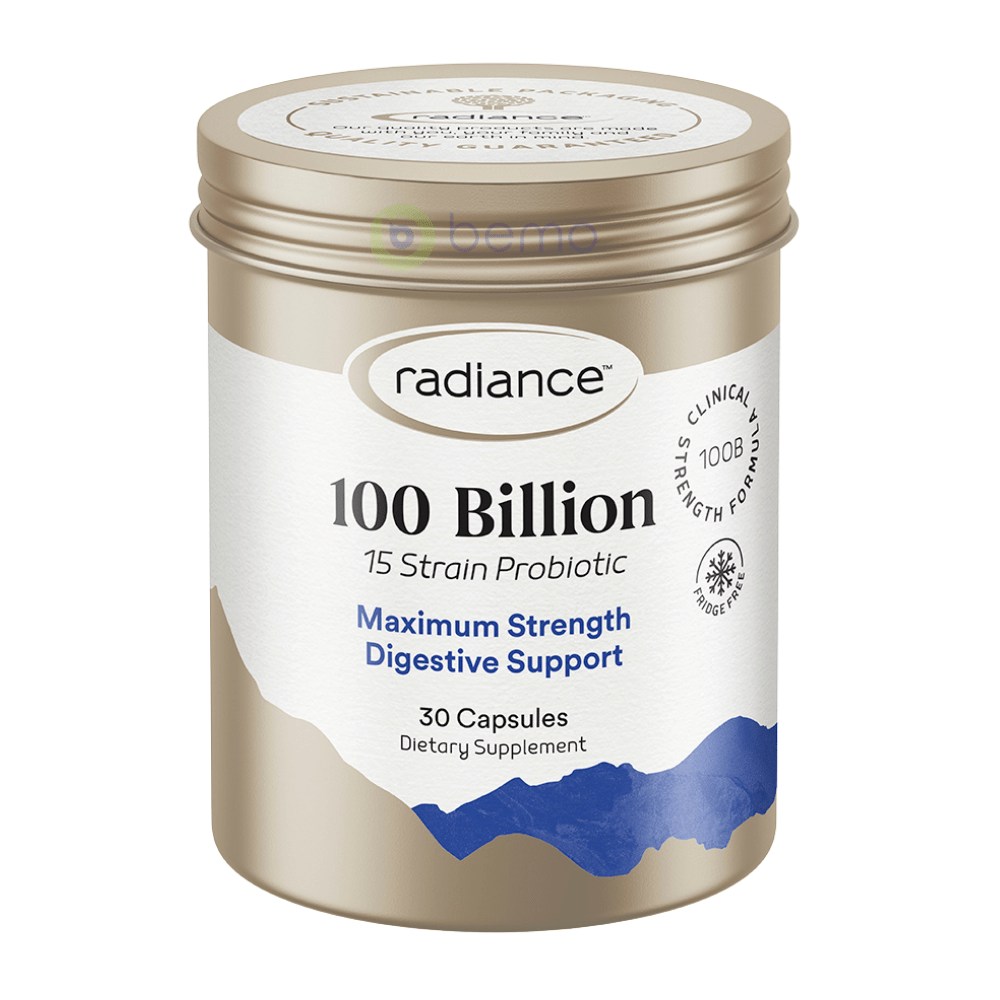
At bemo, we stock a range of probiotic options so you can match the product to your goal. For a high-strength daily capsule, the Radiance Probiotics 100 Billion, 30 Caps is priced at $49.85 and contains 15 strains, with 100 billion CFU at the time of manufacture. If you want a multi-strain option in a different format, the CDS22-Formula Probiotics 112 Billion, 20 caps is priced at $49.85, and the CDS22-Formula Probiotics 450 Billion, 12 Sachets is priced at $58.85 for a higher-potency sachet. Adult vita gummies offer another easy-to-take multi-strain format.

For a gentler, convenient format, the Good Health Pre + Probiotic 90 gummies is priced at $17.85 and combines inulin with Bacillus coagulans. The Radiance Adult Probiotic Gummies 90 are priced at $24.85 and are formulated to be shelf stable, so they do not need refrigeration. For families, the Radiance Kids Probiotic 45 Chewable Tablets are priced at $14.85.
Compare the strain list, dose and storage instructions on each product page before you buy. If you are unsure which option suits you, ask your pharmacist or healthcare professional, and check your label against the points above.
Frequently Asked Questions
How do I choose the right probiotic supplement?
Start with the strain rather than the marketing. Look for named strains at species and strain level, such as Lactobacillus rhamnosus or Bifidobacterium lactis, because the health benefits studied in research tie to specific strains. Next, check that the CFU count is stated as being active at the time of manufacture, not just at packing. Finally, match the product to your goal: a broad multi-strain blend suits general gut support, while a single targeted strain may suit a specific concern. Browse the bemo range and compare labels side by side before you buy.
Does the number of CFUs matter when choosing a probiotic?
CFU count matters, but it is not the only measure. A higher CFU figure means more live cultures, yet the count is only meaningful if the strains are identified and the product states that the count is guaranteed at the end of shelf life. A 100 billion CFU product with well-described strains can be a better choice than a high number with vague ingredients. The clinical dose used in studies varies by strain, so a label figure alone does not show effectiveness. Consider CFU together with strain identity and storage requirements.
How should probiotic supplements be stored?
Storage depends on the product. Some probiotic capsules, such as CDS22-Formula, are kept refrigerated at 2 to 8 degrees Celsius, and may be kept at room temperature for up to one week or whilst being transported. Others, like the Radiance Adult Probiotic Gummies, are formulated with a stable strain so they do not need refrigeration and should be stored in a cool, dry place. Always follow the storage instruction on the label, keep the lid closed tightly, and note the expiry date. Once opened, some products, such as the Radiance Kids Probiotic chewable tablets, are best used within two months.
Are probiotic supplements safe for everyone?
Most people tolerate probiotics well, but some groups should check with a healthcare professional first. This includes anyone who is pregnant or breastfeeding, anyone taking medication, and anyone with a medical condition. Take probiotics at a different time from antibiotics, and follow your product label. Keep all supplements out of reach of children.
Radiance Probiotic and Good Health product prices (NZD)

Leave a comment