

How to Boost Energy Naturally and Beat Daily Fatigue
Last Updated: November 4, 2026
Quick Summary
To boost energy naturally, start by removing habits that drain you, then build on sleep, food, movement and stress management. Get bright outdoor light within an hour of waking, keep consistent sleep and wake times, and build meals around protein, fibre and complex carbohydrates. Supplements only fill gaps in a balanced diet.
- Adults generally need seven to nine hours of sleep, and quality matters as much as quantity.
- Get ten to twenty minutes of bright outdoor light within an hour of waking.
- A simple plate rule: a palm of protein, a fist of vegetables and a cupped hand of complex carbs.
- Stand and stretch every hour, and take a ten-minute walk after lunch.
- Keep coffee before midday and pair it with food, never on an empty stomach.
Table of Contents
- Start With the Habits That Drain Your Energy
- How to Improve Sleep Quality for Energy
- Foods That Provide Sustained Energy Through the Day
- Move More and Sit Less to Lift Energy Levels
- Best Supplements for Fatigue When Your Diet Falls Short
- Manage Stress and Protect Your Mental Clarity
- How to Boost Energy Naturally Without Relying on Caffeine
- Build Your Own Energy Plan With bemo
- Frequently Asked Questions
Start With the Habits That Drain Your Energy
Most people try to boost energy naturally by adding something: a new supplement, an extra coffee, a green smoothie. The faster win is subtraction. Several everyday habits quietly drain the energy you already have, and removing them often does more than adding anything new.
Here is what to stop first:
- Doomscrolling in bed. Screens before sleep push back your body clock and leave you groggy.
- Skipping breakfast, then overeating at night. Blood sugar spikes and crashes follow.
- Relying on coffee to replace food. That caffeine crash hits harder every time.
- Sitting for hours without moving. Sedentary behaviour flattens energy levels fast.
- Ultra-processed snacks as meals. They spike glucose, then drop you flat.
Cut these first. Then build the habits below.
How to Improve Sleep Quality for Energy
Sleep is the foundation of how to boost energy naturally. No supplement replaces restorative sleep. Adults generally need seven to nine hours, and quality matters as much as quantity. But the lever most people miss is timing: your energy today was largely set by the light you saw yesterday, and your energy tomorrow will be set by the light you see today.
Work With Your Circadian Rhythm, Not Against It
Your circadian rhythm is an internal roughly 24-hour clock that governs alertness, hormone release, body temperature and sleep pressure. It is reset mainly by light entering the eyes, especially in the morning. When your light exposure is mistimed, you can sleep eight hours and still wake groggy, because your clock thinks it is still the middle of the night.
The practical sequence is simple:
- Get bright light early. Within an hour of waking, step outside for ten to twenty minutes. Outdoor light is far brighter than indoor lighting, even on an overcast day.
- Keep daytime light bright. Work near a window where you can. Bright daytime light strengthens the signal that separates day from night.
- Dim light in the evening. Two hours before bed, lower lamps, switch to warm bulbs, and avoid overhead downlights. This lets melatonin rise on schedule.
- Keep the dark hours dark. A dark, cool bedroom supports the second half of the night, when restorative deep sleep is concentrated.
Set a Consistent Sleep and Wake Time
Your circadian rhythm runs on routine. Go to bed and wake up at the same time daily, weekends included. A consistent wake time is the anchor; a consistent bedtime follows more easily once the wake time is fixed. This single habit does more for energy than most products.
Build a Wind-Down Routine That Lowers Cortisol
Stress hormone levels naturally fall in the evening. A calm routine can help:
- Dim the lights an hour before bed.
- Put screens away and read instead.
- Try a warm shower or light stretching.
- Keep the bedroom cool and dark.
If sleep still feels hard, a sleep-support option like Natures Way Adult Vita Gummies Sleep Plus 90 Gummies can sit alongside these habits, not replace them.
A simple daily light sequence supports your circadian rhythm and better sleep.
Timing |
What to do |
|---|---|
Within an hour of waking |
Get bright outdoor light for ten to twenty minutes |
During the day |
Keep daytime light bright; work near a window |
Two hours before bed |
Dim lights, use warm bulbs, avoid overhead downlights |
Night |
Keep the bedroom dark and cool |
Foods That Provide Sustained Energy Through the Day
Foods that provide sustained energy often combine protein, fibre, and complex carbohydrates, which digest more slowly than refined sugars.
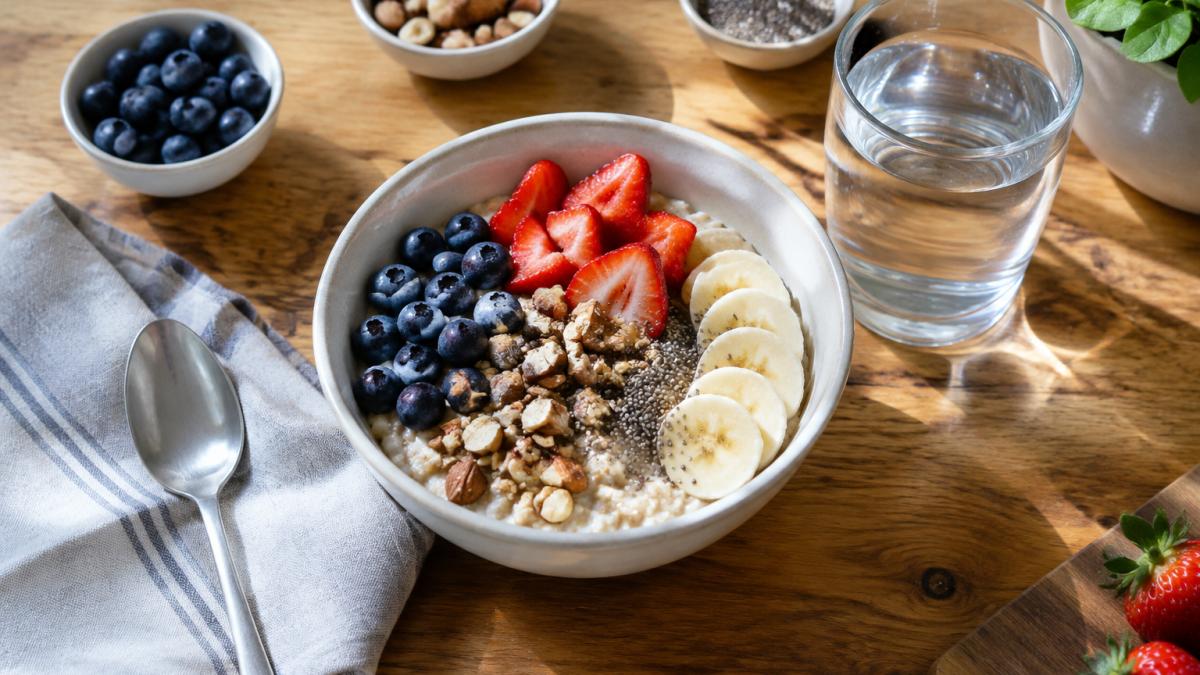
Infographic showing a balanced breakfast bowl with oats and berries as a source of sustained daily energy
Build Meals Around Protein, Fibre and Complex Carbohydrates
A simple plate rule works well: a palm of protein, a fist of vegetables, and a cupped hand of complex carbohydrates like oats, kumara, or brown rice. Add healthy fats.
Snack Smart and Avoid the Caffeine Crash
Reach for snacks that combine protein and fibre:
- Apple slices with peanut butter
- Yoghurt with nuts
- Hummus with carrot sticks
- A boiled egg and wholegrain crackers
These combinations tend to keep hunger and energy more even.
Move More and Sit Less to Lift Energy Levels
Many people find that physical activity helps with tiredness. Even a short walk can leave you feeling more alert.
Break up sedentary behaviour with small moves:
- Stand and stretch every hour.
- Take a ten-minute walk after lunch.
- Use stairs instead of the lift.
- Try two minutes of movement between meetings.
Staying hydrated also supports how you feel through the day. Keep a water bottle on your desk and sip through the day.
Best Supplements for Fatigue When Your Diet Falls Short
Supplements are best used to fill gaps in a balanced diet, not to replace meals.
B vitamins contribute to normal energy-yielding metabolism, which is why B complexes are a common choice for energy support.
What to Look For on the Label
Check these before buying:
- Active forms: look for B12 and P5P.
- Clear doses: every vitamin listed in milligrams or micrograms.
- Few fillers: short ingredient lists with no artificial colours.
- Format: tablets, capsules, gummies, or liquids suit different routines.
A few options from our range:
- Clinicians Stress Energy Support Vcaps 60 pairs energy support with stress support.
- Good Vitamin Co Vita B12 Energy Boost 90 Gummies suits anyone wanting a convenient B12 boost.
- Now Foods B 100 Sustained Release B Complex 100 Tablets offers a sustained-release B complex.
Watch out: supplements support a balanced diet, they do not replace one. If you take medication, check with your pharmacist first.


Manage Stress and Protect Your Mental Clarity
Ongoing stress can make tiredness feel worse, and it often affects focus. Managing it is part of any real plan to boost energy naturally. But most advice treats tiredness as one thing. It is not. Physical fatigue and emotional or mental fatigue feel similar and need different responses, and confusing them is why people rest and still feel drained.
Tell Physical Fatigue and Mental Fatigue Apart
Physical tiredness often eases with rest, food, water and movement. Mental tiredness can ease with a different kind of recovery, such as reducing decisions and giving your attention genuine breaks.
A useful self-check:
- Physical fatigue: heavy limbs, sluggish movement, better after a meal, a walk or a nap.
- Mental fatigue: flat motivation, short fuse, poor concentration, scrolling instead of deciding, and no improvement after rest.
If rest does not restore you, the drain is likely cognitive or emotional rather than physical. That changes what to do next.
Reduce Decision Load and Attention Drain
Mental fatigue accumulates through small, constant choices and fragmented attention. Practical ways to cut it:
- Batch decisions. Plan meals, outfits and work priorities once, so you are not re-deciding them all day.
- Protect focus blocks. Turn off non-essential notifications for set periods and work on one task at a time.
- Schedule recovery, not just breaks. A short walk without a phone restores attention better than a break spent scrolling.
- Close open loops. Write down unfinished tasks so your mind stops holding them.
Use Stress Management Techniques That Fit the Type of Fatigue
- Breathe slowly. Four counts in, six counts out, for two minutes.
- Move daily. A brisk walk can be a good way to clear your head.
- Set boundaries. Protect focus time and log off properly, so work does not follow you into the evening.
- Get outdoors. Daylight supports mood and sleep, and it doubles as circadian input.
- Ask for help. Talking to a GP or counsellor is a strength, not a weakness, especially when low mood or persistent exhaustion is involved.
Watch out: if fatigue is persistent, unexplained, or paired with low mood, sleep problems or weight change, see a GP rather than self-treating with supplements.
For stress-related tension that affects sleep, Now Foods Magnesium Citrate 90 Softgels can support your routine.

Now Foods, Magnesium Citrate, 90 Softgels
How to Boost Energy Naturally Without Relying on Caffeine
You can work on energy without caffeine by focusing on the basics first: sleep, food, water, and movement. Used well, it is fine. Used as a crutch, it drives the crash cycle.
A caffeine-smart approach:
- Keep coffee before midday.
- Pair it with food, never on an empty stomach.
- Cap intake and switch to water after lunch.
- Use gentle options like guarana or B vitamins when you want a lift.
The Ministry of Health's eating and activity guidance is a solid starting point for building daily habits around food and movement.
Build Your Own Energy Plan With bemo
A plan beats guesswork. Here is a simple weekly checklist to boost energy naturally:
- Same sleep and wake time, seven days
- Protein, fibre, and complex carbs at each meal
- Two litres of water daily
- A short walk after lunch
- Screens off one hour before bed
- One stress-busting habit daily
Track it for two weeks to see how you feel.
At bemo, we offer a range of vitamins and supplements, including B-vitamin products that can be a practical starting point. Fast delivery within New Zealand and a focus on sustainable and organic ingredient sourcing are part of how we work.
Get started with bemo and build steady, natural energy into your day.
Frequently Asked Questions
What are the best natural supplements for energy?
B vitamins are the most direct option because they help convert food into usable energy. A full B complex covers B1, B2, B3, B5, B6 and B12, and formats like effervescent tablets or liposomal liquids are absorbed quickly. Guarana adds a gentle caffeine lift for alertness. Look for products with clear per-serving ingredient amounts and no artificial colours or sweeteners, and check the label for pregnancy and medication warnings before you start.
Does dehydration cause fatigue?
Staying hydrated supports how you feel through the day, and thirst is sometimes mistaken for tiredness. Keep a water bottle within reach and sip through the day rather than drinking a large amount at once.
How can I boost energy naturally without caffeine?
To boost energy naturally without caffeine, focus on the basics first: a consistent sleep and wake time, protein and fibre at each meal to avoid blood sugar spikes, and short walks to break up sedentary behaviour. Daylight in the morning helps set your circadian rhythm. If you want supplement support, a
Which foods are best for sustained energy throughout the day?
Foods that provide sustained energy combine protein, fibre and complex carbohydrates. Oats with Greek yoghurt and berries, wholegrain toast with eggs, lentil or chickpea salads, and nuts with fruit all release glucose slowly. Cut back on ultra-processed foods and sugary drinks, which give a quick lift and an equally quick drop, and eat at regular times to keep energy levels steady.

Leave a comment